
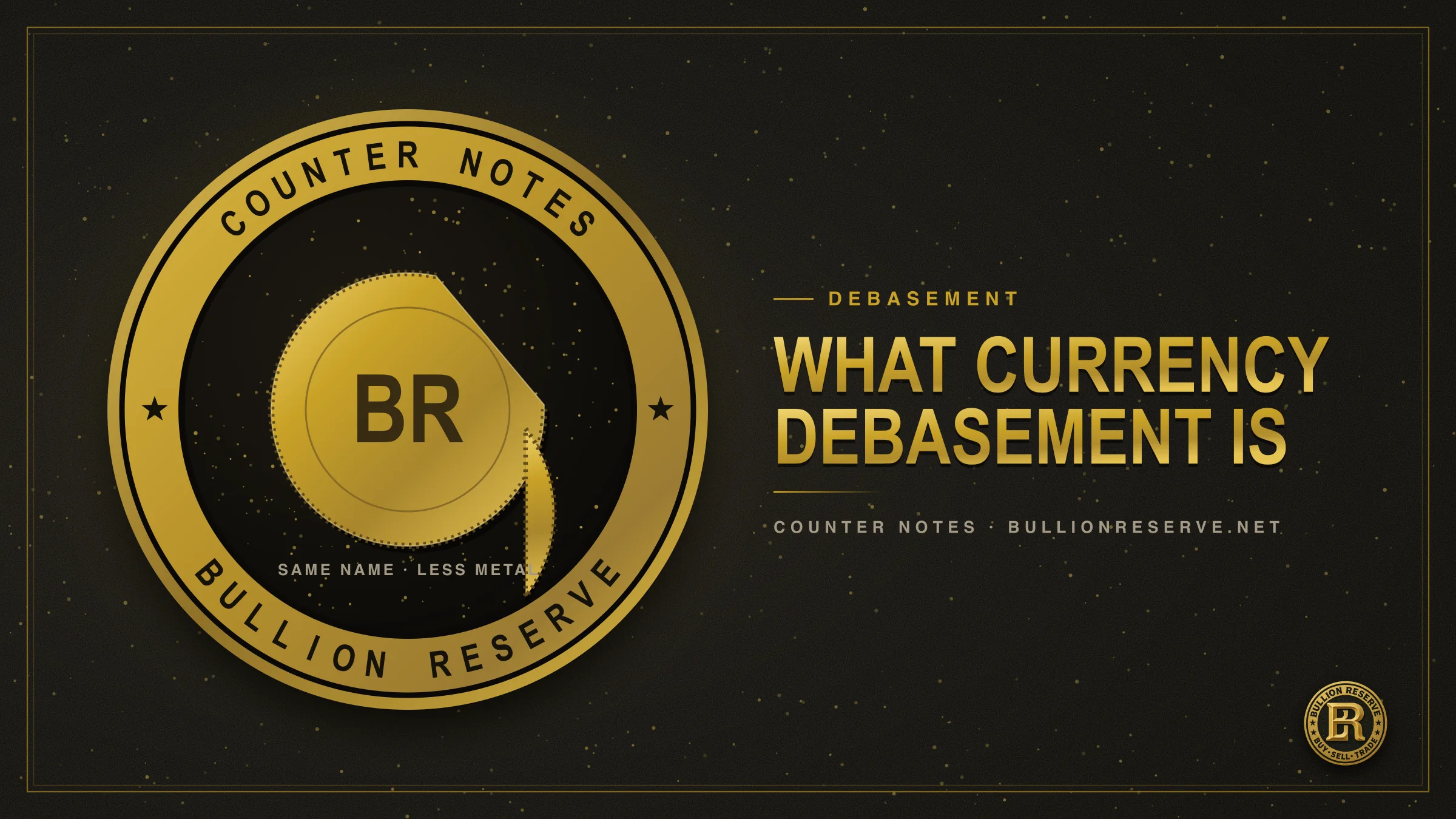
What currency debasement is, and why it never looks like theft at the time
August 27, 2026 · By Bullion Reserve
Debasement is when the thing called a dollar, or a denarius, or a shilling, comes to contain less than it did, while the name stays the same. It has been done with a shears, a furnace and, now, a keyboard.
The word
“Debase” was a metalworker’s word before it was an economist’s. A coin has a base, the metal it is made of, and to de-base it is to make that base cheaper: less silver in the alloy, more copper, the same stamp on top. Debasement is keeping the name of the money while reducing what stands behind it.
The name is what makes it work. A debased coin is still called a denarius or a shilling or a dollar, the law still says it settles the same debt, and the tax collector still takes it at face. Only the thing itself has changed, and the change is meant to be hard to see from across a market stall.
Three ways to do it
Clip and sweat
The oldest method needed no permission from anyone. Hammered coins had ragged edges, and a pair of shears could take a sliver of silver off each one that passed through your hands. A purse of gold coins shaken in a leather bag for an hour left a dusting of gold in the seams. The clipped coins went back into circulation at face value and the clippings went to the melting pot.
The answer was the edge. In 1662 the Royal Mint began striking coins by machine, and the new pieces carried a lettered or grooved edge that would show the moment anyone took a shaving off it. The larger silver bore the inscription DECUS ET TUTAMEN, “an ornament and a safeguard,” and the safeguard was against the shears. The United States Mint reeded the edges of its first silver in the 1790s for the same reason. Look at the edge of any quarter in your pocket. The ridges are still there, protecting a coin that has held no silver since 1965, and nobody has clipped a quarter in living memory.
Alloy
The second method belongs to the mint itself. Instead of removing metal at the edge, the issuer puts less of it in from the start: the same weight of coin, a lower share of silver, and a proclamation that nothing has changed. The Roman denarius was roughly 95% silver or better under Augustus, under half silver by the 190s and about 2 to 5% by the 270s, a copper disc with a silver wash. Henry VIII’s shillings fell from eleven-twelfths silver to roughly a third by 1546. The silver wore off the high points of his portrait first, which is how the king earned the name Old Coppernose. The American version was harder to see. After 1964 the quarter went from 90% silver to a copper core clad in copper-nickel, and the reeding, the size and the design stayed as they were. That story, the last silver coins, gets its own post.
Once money is paper, or a number in a ledger, no metal has to be removed at all. The issuer makes more units, and each unit that already exists becomes a smaller share of whatever the money can buy. The result is the same as the shears and the furnace, with cleaner hands.
The record is easy to read. The Bureau of Labor Statistics’ consumer price index stood at 9.9 for 1913, its first year. The latest reading, for July 2026, is 333.918, so what a dollar bought in 1913 takes roughly 34 dollars now. Not every step of that path was a decision at the mint, as the section on inflation below explains, and the figure is history rather than a forecast. But the shape of it is the denarius again, this time drawn with a keyboard.
Why it is done
The reason has not changed in 2,000 years. The issuer needs to spend more than it collects, whether on a war or a court or a city that burned down, and there are three ways to close the gap: tax, borrow, or thin the money. Taxes are visible and resented, and borrowing has to be repaid. Debasement is a tax nobody votes on, and few notice it until the prices arrive. Nero cut the denarius after the fire of AD 64 with a city to rebuild. Henry VIII debased to pay for wars with France and Scotland. The Continental Congress, which had no power to tax at all, printed its way through a revolution, and the phrase “not worth a Continental” is what was left.
Who pays
The people who lose are the people holding the old money or promised a fixed sum of the new: savers, wage-earners, pensioners, creditors, soldiers whose pay was set at a number of coins. The people who gain are the issuer and whoever spends the new money first, the treasury’s contractors and the paymaster, before the rest of the market has noticed that there is more of it.
Richard Cantillon, an Irish banker working in Paris, wrote this down in an essay composed around 1730 and printed in 1755. New money does not raise all prices at once. It enters the economy somewhere and spreads outward, and those nearest the source spend it at old prices while those farthest away meet the new ones. Economists call it the Cantillon effect, and it is why the last people to hear about a debasement are usually the ones who paid for it.
Debasement vs inflation
The two words get used as one and they are not the same thing. Inflation is the symptom, a general rise in prices. Debasement is one of its causes, and only one. A bad harvest raises the price of bread without anyone touching the mint, and so does a blockade, a plague or a rush of new demand, so not every price rise is a debasement.
Every debasement does show up in prices eventually, though. A coin with half the silver buys half the wheat once the merchants work it out, and they always do. Rome’s money-changers worked it out, and so did Tudor London’s goldsmiths and a Michigan grocer in 1965. The lag between the thinning and the noticing is the issuer’s whole profit. There is a second symptom, older than the word inflation, which is that the good coins disappear. People spend the debased pieces and keep the full-weight ones in a jar, which is why hoards dug up today are so often full of the better money.
Why gold and silver are the measuring stick
You cannot alloy a bar into more bars. An ounce of fine gold is an ounce, and the only ways to have more of it are to dig it out of the ground or to trade for it with someone who did. That is why every debasement in history has been measured against metal. The price of gold in denarii, or in shillings, or in dollars, is the ledger of how thin each money became, and what it records is the unit getting smaller, since the metal itself did not change. Why gold is money, and why nearly every other element fails the same tests, is the next post.
What comes next
The posts that follow take the pattern one case at a time. The Roman denarius is the textbook case, told by the numbers, and the Continental is the American one. Executive Order 6102 is what happened in 1933 when the dollar’s gold definition became inconvenient, August 15, 1971 is when the last of it was cut loose, and debasement, then and now puts the keyboard beside the shears.
The counter’s footnote
At the counter the question is what is in a piece of money, never what it is called. Every coin, bar and ring that crosses the bench is weighed and tested in front of you, and the answer comes back as a weight and a fineness. The live spot at the top of this page turns that into a figure. A dollar has been redefined many times since 1792 and a troy ounce has not. For metal that can’t be debased: what the counter stocks, the rule is one Rome’s money-changers would have understood. Weigh it and test it, then talk.
Know what it's worth before you sell it anywhere.
Free evaluation at the counter — tested in front of you, priced off the day's spot.