
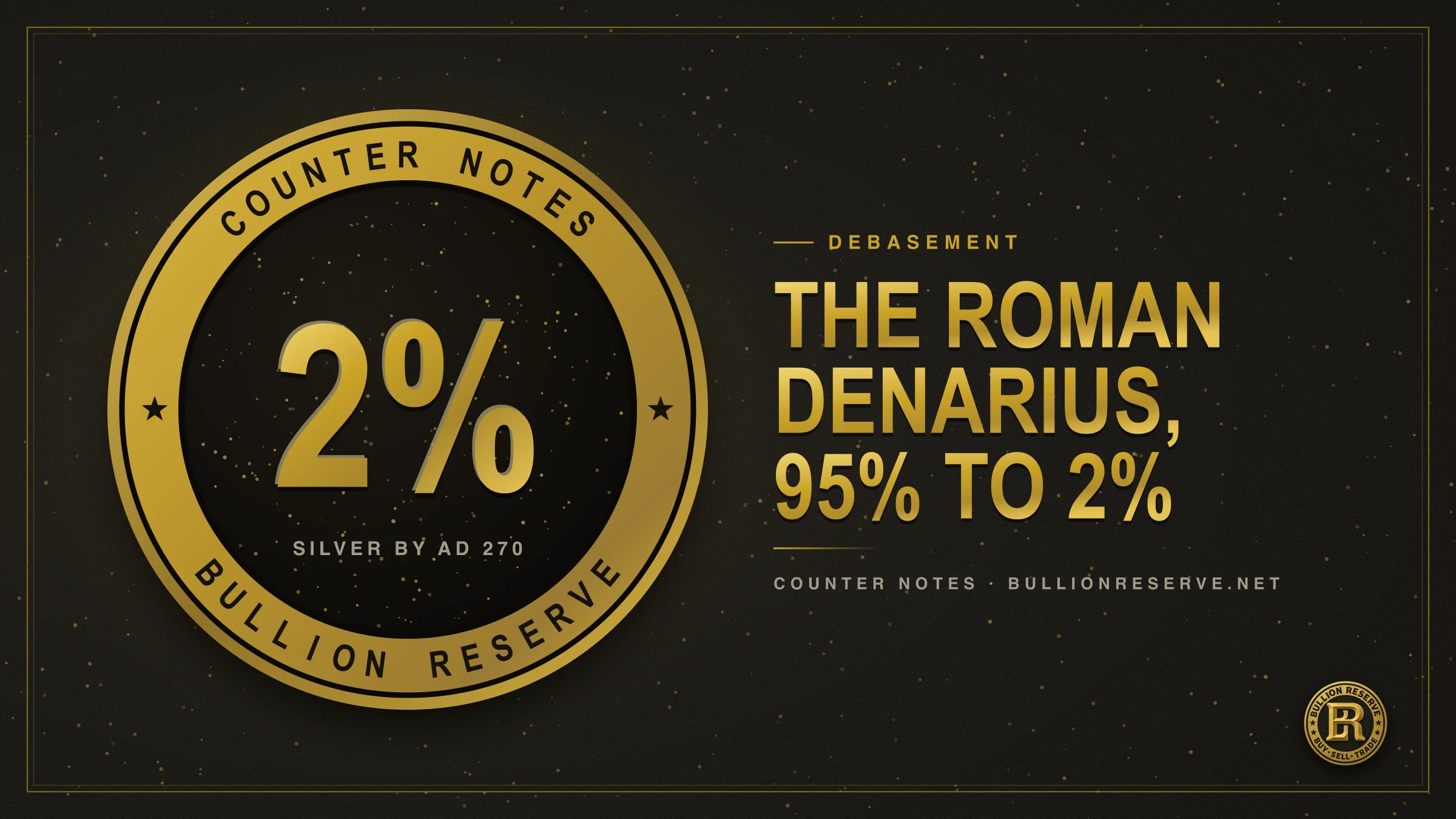
The Roman denarius: from 95% silver to 2% in 250 years
September 28, 2026 · By Bullion Reserve
Hold a denarius of Augustus and one of Gallienus and you are holding the same name on two different things: one is silver, the other is a copper disc dipped in it. The road between them took 250 years, and every step was a budget decision.
A coin you could trust
The denarius Augustus left behind in AD 14 weighed about 3.9 grams (the Roman mint cut 84 of them from a pound of silver), and the metal was as good as the refiners could make it, 95 to 98% silver by modern analysis. A merchant in Gaul or Syria took one at face because the face was the metal.
It was also the coin a soldier was paid in. Under Augustus a legionary earned 225 denarii a year, before deductions for food and kit, and when the Rhine legions mutinied in AD 14 Tacitus has them complaining that they were paid ten asses a day. A denarius was 16 asses, so a single coin was a little more than a day and a half of a soldier’s gross pay. That is the scale to keep in mind for what follows. The state’s largest bill, by far, was the army, and the army was paid in silver.
Nero’s first cut, AD 64
In July of AD 64 fire destroyed or badly damaged ten of Rome’s 14 districts. Nero rebuilt the city on a grander plan, laid out the Golden House across the ruins of three of those districts, and kept the legions paid, and the money for all of it did not exist. His answer was the mint. From AD 64 the pound of silver was cut into 96 denarii instead of 84, so the coin fell from about 3.9 to about 3.4 grams, and the alloy was thinned at the same time. How far it was thinned is disputed. Harl’s figures put the new denarius at about 93% silver, while Butcher and Ponting’s recent analyses, which drill past the enriched surface that fooled earlier tests, put it closer to 80%. Either way the coin was lighter and the lighter coin held less, and the name on it did not change.
Nero did not debase the denarius because he had a theory of money. He did it because a rebuilt capital and a standing army cost more than the taxes brought in, and the mint was the one place a shortfall could be closed without anyone voting on it.
The staircase
The ranges below follow Harl and Butcher and Ponting, and the exact figure for any reign depends on which coins were analyzed and how.
Augustus (27 BC to AD 14): about 3.9 g, 95 to 98% silver
Nero, after AD 64: about 3.4 g, roughly 80 to 93% silver, depending on whose analysis
Trajan (98 to 117): roughly 85 to 90%, with a recall and recoining of the old, better money around AD 107
Marcus Aurelius (161 to 180): roughly 75 to 80%
Commodus (180 to 192): roughly 70 to 75%
Septimius Severus (193 to 211): roughly 45 to 55%, the first cut below half. Legionary pay was raised to somewhere between 400 and 500 denarii (estimates differ) and raised again by his son
Caracalla, AD 215: the antoninianus, a new coin tariffed at two denarii but weighing about 5.1 g, roughly one and a half denarii’ worth of silver at about 50% fine
Gallienus (260 to 268): the antoninianus at roughly 2 to 5% silver, a copper-alloy disc given a silver wash at the mint that wore off in use
Between Severus and his son, army pay roughly doubled in a generation, and the silver to pay it did not exist. The antoninianus was the accounting trick that squared it, a coin the treasury could call two denarii and pay out at two while putting in one and a half. The denarius itself faded out of production in the 240s, and by the 260s a Roman was handed, at the same face value, a piece of money that a moneyer of Augustus would not have recognized as silver at all.
What it felt like
Egypt kept the receipts. Its papyri record wheat prices for three centuries, and for most of that time they are steady. Between AD 166 and 249 wheat sold for 12 to 24 drachmas an artaba, around 17 on average. Then came Aurelian’s currency reform of 274 to 275, and within a year or two prices were about ten times what they had been. By the early fourth century they were in the hundreds of drachmas per artaba and still climbing. Rathbone reads the jump as the market suddenly repricing a coin whose silver was gone rather than as slow inflation, and either reading ends with a farmer needing ten times the coins for the same grain.
The good money went to ground. Hoards buried in the third century are full of the older, heavier denarii and thin on the coin of the day. People spent what the state gave them and kept what it used to give them, which is Gresham’s law working as it would in Tudor England or 1965 Michigan. The state noticed too. In AD 260 the governor of the Oxyrhynchite district in Egypt had to order the bankers, who had closed their exchanges rather than accept the emperors’ coin, to reopen and take it.
Diocletian tries to fix it, AD 294 to 301
Diocletian, emperor from 284, inherited a currency nobody trusted and an empire he made a great deal more expensive to run. His first move was sound. Around 294 he reformed the coinage, striking a new silver argenteus at Nero’s old weight of 96 to the pound and in good metal, alongside a large silver-washed bronze. His second was to double the face value of the coinage by decree in September 301, and prices rose to meet it.
His third move, late in 301, was the Edict on Maximum Prices. It set ceilings on more than a thousand goods and services across the whole empire (wheat, wine, beef, a haircut, a laborer’s day), and the penalty for charging more, or for withholding goods from sale, was death. We have it because cities carved it in stone. Large fragments survive at Aphrodisias and Stratonikeia in Turkey, among more than 40 sites. Lactantius, who was teaching in Diocletian’s capital at Nicomedia when it was posted, wrote its epitaph a dozen years later:
Then much blood was shed for the veriest trifles; men were afraid to expose anything to sale, and the scarcity became more excessive and grievous than ever.
Lactantius was a hostile witness, a Christian writing about a persecutor, but the outcome he describes is what price ceilings have done every time since. Goods left the market, and the edict was dead within a few years. Price controls are the second act of every debasement, because a government that has thinned its money will look everywhere but the mint for the reason prices rose.
Why this is the case people cite
“Rome fell because it debased its money” is too neat. The western empire outlived Gallienus by two centuries and the eastern by more than a thousand years, and Constantine’s gold solidus, struck at 72 to the pound from about 309, held its weight for roughly 700 years. Debasement did not end Rome.
What the 250 years between Augustus and Gallienus do show is the pattern set out in what currency debasement is. A state under fiscal strain will thin its money before it cuts its spending, and will then blame the merchants for the prices. Rome did it with a furnace. The Continental Congress did it 1,500 years later with a printing press, and “not worth a Continental” is the American telling. The tools change and the budget decision does not.
The counter’s footnote
A Roman money-changer sat behind a table with a touchstone and a balance. The balance told him the weight. The stone, streaked with the coin and compared against needles of known fineness, told him roughly what the surface was made of. Against Gallienus’s antoninianus that was not enough, because the surface was silver and the inside was not, and a touchstone cannot see through a wash. What comes across this counter is weighed on a calibrated scale and tested through the surface, in front of you: the counter’s test is the one Rome’s money-changers lacked. The scale is the same idea, and the rest is 1,700 years of catching up.
Know what it's worth before you sell it anywhere.
Free evaluation at the counter — tested in front of you, priced off the day's spot.